
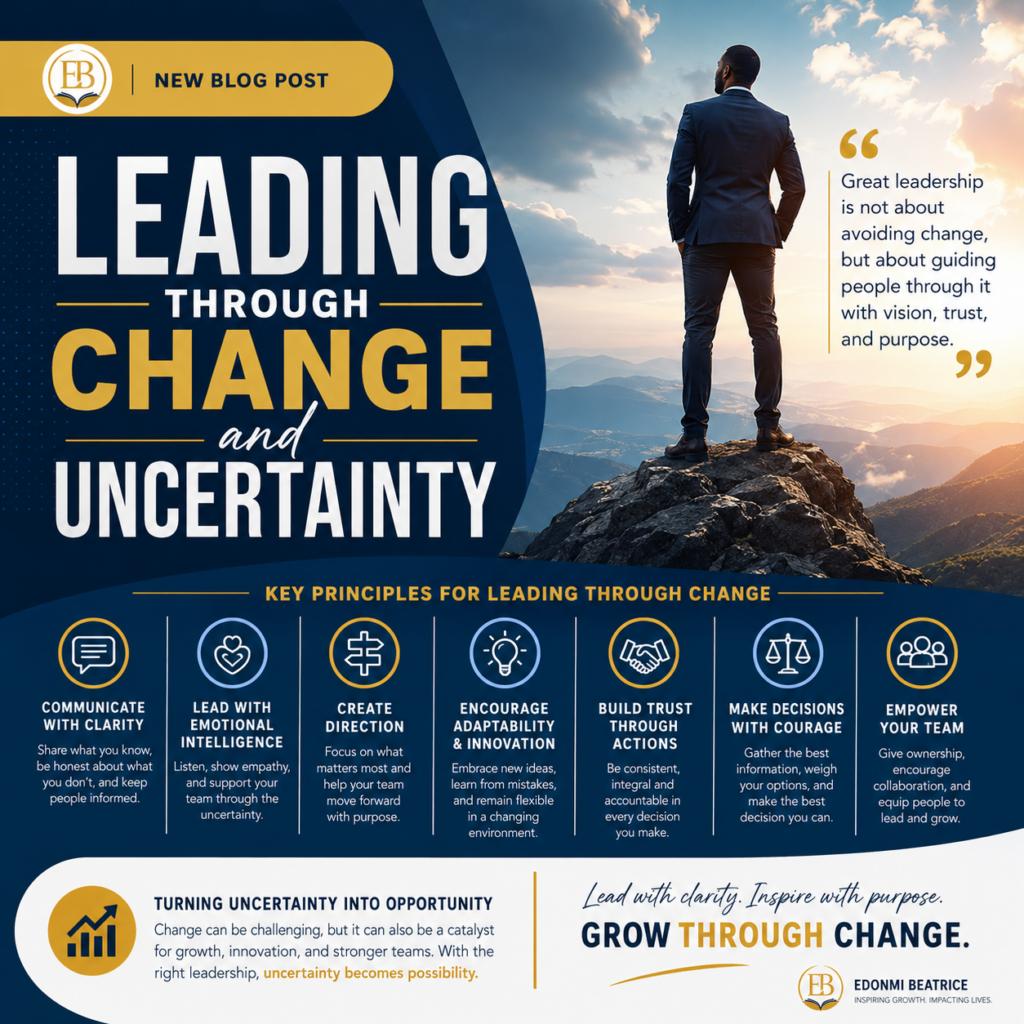
Leading Through Change and Uncertainty
When the future is uncertain, your people may not need you to have all the answers.
Change is inevitable. Whether it comes through organizational restructuring, technological advancement, economic pressure, shifting customer expectations, or unexpected challenges, leaders are often called upon to guide people through situations where the path forward is not always clear.
Leading through change and uncertainty is not about having all the answers. It is about providing clarity, building trust, remaining adaptable, and helping people move forward with confidence.
Understanding the Nature of Change
Change can create excitement, but it can also create fear and resistance. People naturally seek stability, and uncertainty can make employees question their roles, responsibilities, and future.
Effective leaders recognize that resistance is not always a sign of unwillingness. Sometimes, it is a response to uncertainty. Leaders who take time to listen, acknowledge concerns, and communicate openly create an environment where people feel valued and supported.
Communicate With Clarity and Consistency
During uncertain times, communication becomes one of a leader’s most powerful tools.
Lead With Emotional Intelligence
Change affects people differently. Some individuals adapt quickly, while others need more time to process what is happening.
Emotionally intelligent leaders pay attention not only to performance but also to morale, motivation, and wellbeing. They create opportunities for employees to express concerns without fear of judgment.
Empathy does not mean avoiding difficult conversations. Rather, it means approaching difficult situations with understanding, respect, and humanity.
Create a Sense of Direction
When everything seems uncertain, people need a clear sense of purpose.
A strong leader helps the team focus on what can be controlled rather than becoming overwhelmed by what cannot. This may involve establishing short-term priorities, defining measurable goals, and celebrating progress along the way.
Instead of trying to predict every possible outcome, effective leaders ask:
What is the most important thing we need to accomplish now?
This approach transforms uncertainty from a source of anxiety into an opportunity for focused action.
Encourage Adaptability and Innovation
Organizations that thrive during change are often those that are willing to learn and adapt.
Leaders should encourage teams to challenge outdated processes, explore new ideas, and learn from mistakes. Creating a culture where people feel safe to experiment can unlock creative solutions to emerging challenges.
Adaptability is no longer simply a desirable leadership skill. In a rapidly changing world, it is essential.
Build Trust Through Your Actions
Trust is built through consistency between what leaders say and what they do.
When leaders demonstrate integrity, take responsibility, keep their commitments, and make decisions based on clear principles, they strengthen organizational trust.
During difficult periods, employees watch leadership closely. They want to know whether their leaders will remain calm, fair, and accountable when circumstances become challenging.
Leadership credibility is often tested most when uncertainty is highest.
Make Decisions With Courage
Uncertainty can make decision-making difficult. Leaders may be tempted to wait until they have complete information, but in many situations, complete information is impossible.
Effective leaders gather the best information available, evaluate risks, seek appropriate input, and make informed decisions. They remain willing to adjust their approach when new information emerges.
Good leadership is not about always making perfect decisions. It is about making responsible decisions, learning from outcomes, and continuing to move forward.
Empower Your Team
Leaders cannot navigate change alone.
Empowering employees to take ownership, solve problems, and contribute ideas creates stronger and more resilient teams. When people feel that they have a meaningful role in shaping the future, they are more likely to embrace change rather than simply endure it.
Leadership during uncertainty should therefore move beyond giving instructions. It should involve equipping people to think, act, collaborate, and lead.
The leaders who succeed are not necessarily those who experience the least uncertainty. They are those who know how to lead effectively despite it.
CONCLUSION
When the future is uncertain, your people may not need you to have all the answers. They need you to provide direction, communicate honestly, listen with empathy, and give them the confidence to move forward.
About The Author
Discover more from Gifted Magazine
Subscribe to get the latest posts sent to your email.