
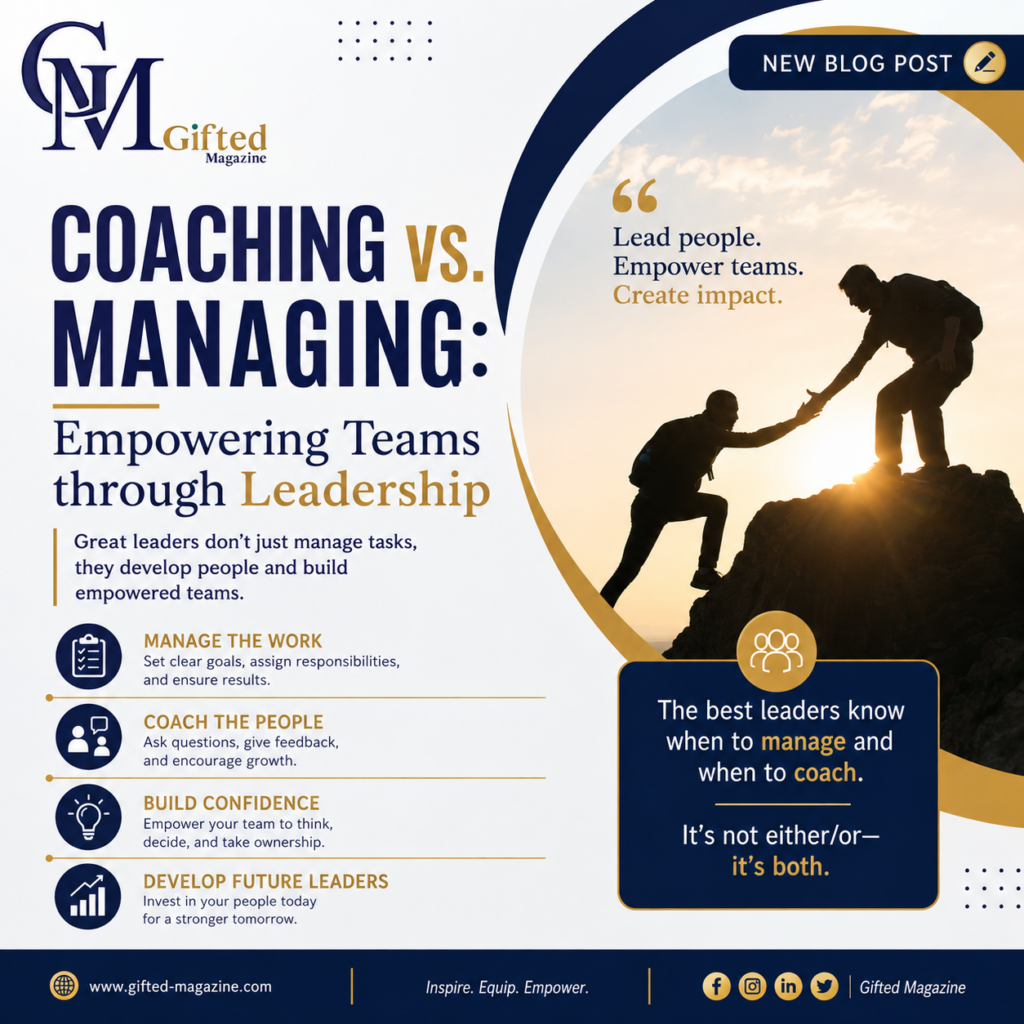
Coaching vs. Managing
Managing gives people direction. Coaching gives them development. Empowerment gives them ownership.
Coaching vs. Managing, Empowering Teams Through Leadership
In today’s fast-changing workplace, effective leadership requires more than assigning tasks and monitoring results. Great leaders understand that the success of an organization depends not only on what employees accomplish, but also on how they are supported, developed, and empowered.
This is where coaching and managing become important.
Although the two approaches are different, they are not opposites. A strong leader knows when to manage the work and when to coach the people behind it.
Understanding the Difference
Managing is primarily focused on performance, structure, responsibilities, and results. Managers set expectations, assign tasks, establish deadlines, and ensure that goals are achieved.
Coaching, on the other hand, focuses on people and their development. A coach helps employees identify their strengths, overcome challenges, develop new skills, and become more confident in making decisions.
Managers focus on getting the work done. Coaches focus on helping people become better at doing the work.
Both are necessary for a successful team.
1. Managing Provides Direction
Every team needs clear direction. Employees need to understand what is expected of them, what their responsibilities are, and what goals they are working toward.
Effective management provides this structure. A good manager sets clear expectations, communicates deadlines, delegates responsibilities, and monitors progress.
Without proper management, even talented employees can become confused about priorities.
However, leadership should not stop at giving instructions.
2. Coaching Builds Confidence
Employees do not always need their leaders to provide all the answers. Sometimes, they need someone who will help them discover the answers for themselves.
A coaching leader may ask questions such as:
• What do you think is the best approach?
• What challenges are you facing?
• What could we do differently?
• What support do you need?
These questions encourage employees to think critically and take ownership of their work.
Over time, coaching can help transform employees from people who simply follow instructions into people who confidently contribute ideas and make decisions.
3. Feedback Should Lead to Growth
Feedback is an important part of both management and coaching.
However, effective feedback should not simply point out mistakes. It should help people understand what they can improve and how they can improve it.
Instead of saying, “You did this incorrectly,” a leader can explain the issue, acknowledge what was done well, and discuss a better approach for the future.
When feedback is constructive and respectful, employees are more likely to see it as an opportunity to grow rather than as criticism.
4. Empower Your Team to Take Ownership
One of the greatest signs of effective leadership is seeing employees take responsibility without waiting for constant instructions.
Leaders can encourage this by giving team members meaningful responsibilities and allowing them to participate in decision-making.
Of course, empowerment does not mean leaving employees without support. Leaders should remain available to guide, encourage, and provide resources when necessary.
5. Know When to Manage and When to Coach
Not every situation requires coaching, just as not every situation requires direct management.
During an emergency or when a task has strict requirements, employees may need clear and immediate instructions.
In situations involving learning, problem-solving, or professional development, coaching may be more effective.
The best leaders learn to read the situation and choose the approach their team needs.
Leadership is not about using one method all the time. It is about knowing what works, when it matters most.
Conclusion
Managing gives people direction. Coaching gives them development. Empowerment gives them ownership.
When leaders manage effectively and coach intentionally, they create teams that are not only productive but also confident, innovative, and prepared for the future.
Ultimately, great leadership is not measured only by what a leader achieves personally. It is also measured by the people they help grow.
Manage the work. Coach the people. Empower the team. Build leaders for tomorrow.
About The Author
Discover more from Gifted Magazine
Subscribe to get the latest posts sent to your email.