DESIGN THINKING FOR ENTREPRENEURS
Design thinking is more than a creative technique.
In today’s fast-changing business environment, having a great idea is no longer enough. Markets evolve, customer expectations shift, technology continues to disrupt industries, and organization’s are constantly challenged to do more with less.
For entrepreneurs the ability to identify meaningful problems and develop solutions that people genuinely need has become a powerful competitive advantage.
This is where design thinking comes in.
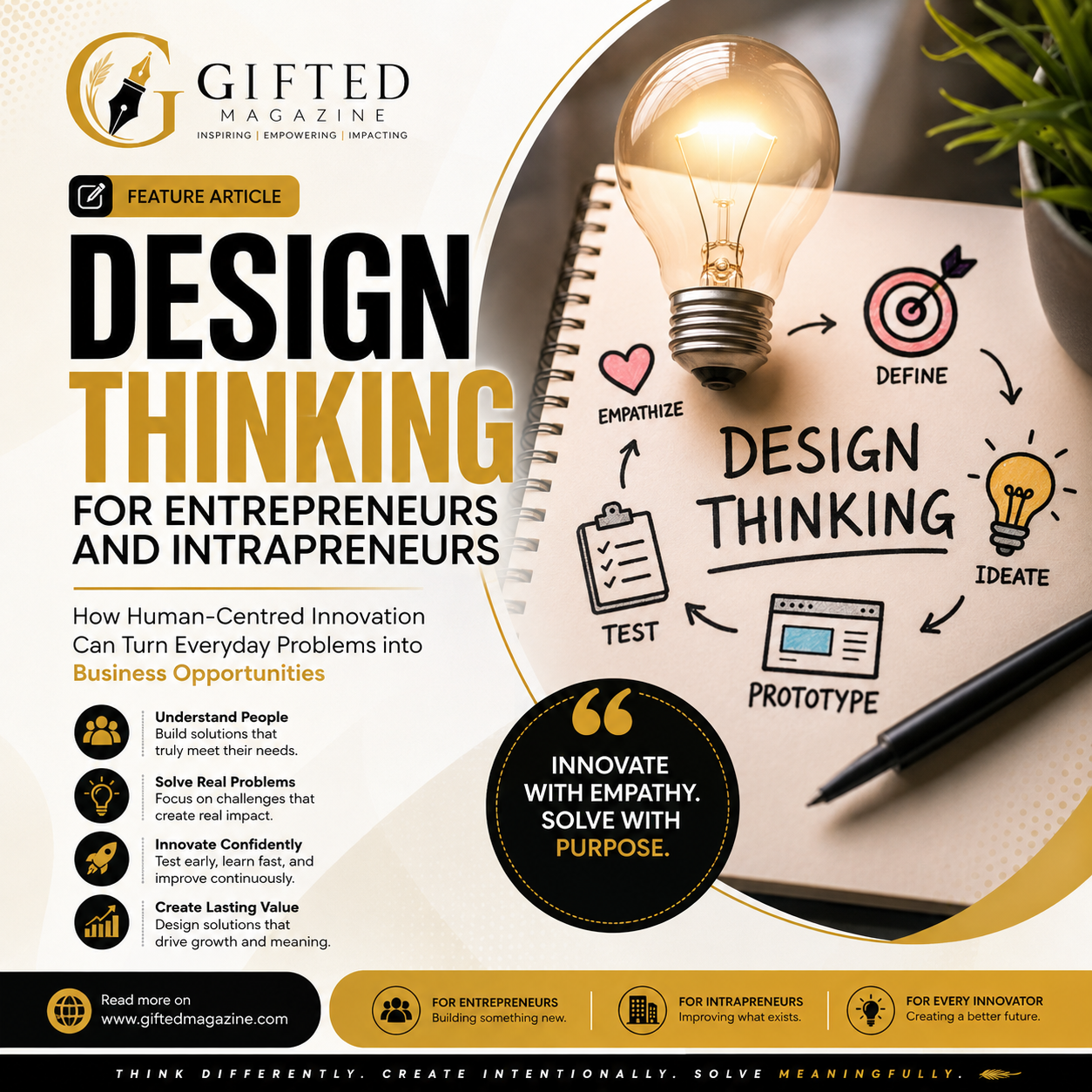
Design thinking is more than a creative technique. It is a human-centred approach to innovation that encourages us to understand people, challenge assumptions, explore possibilities, test ideas, and continuously improve solutions.
For the entrepreneur building a new business or the employee seeking to transform an existing organization, design thinking provides a framework for turning uncertainty into opportunity.
What Exactly Is Design Thinking?
Design thinking is an approach to problem-solving that places people and their experiences at the centre of the process.
It begins by asking:
“What do people actually need, and what problem are we trying to solve?”
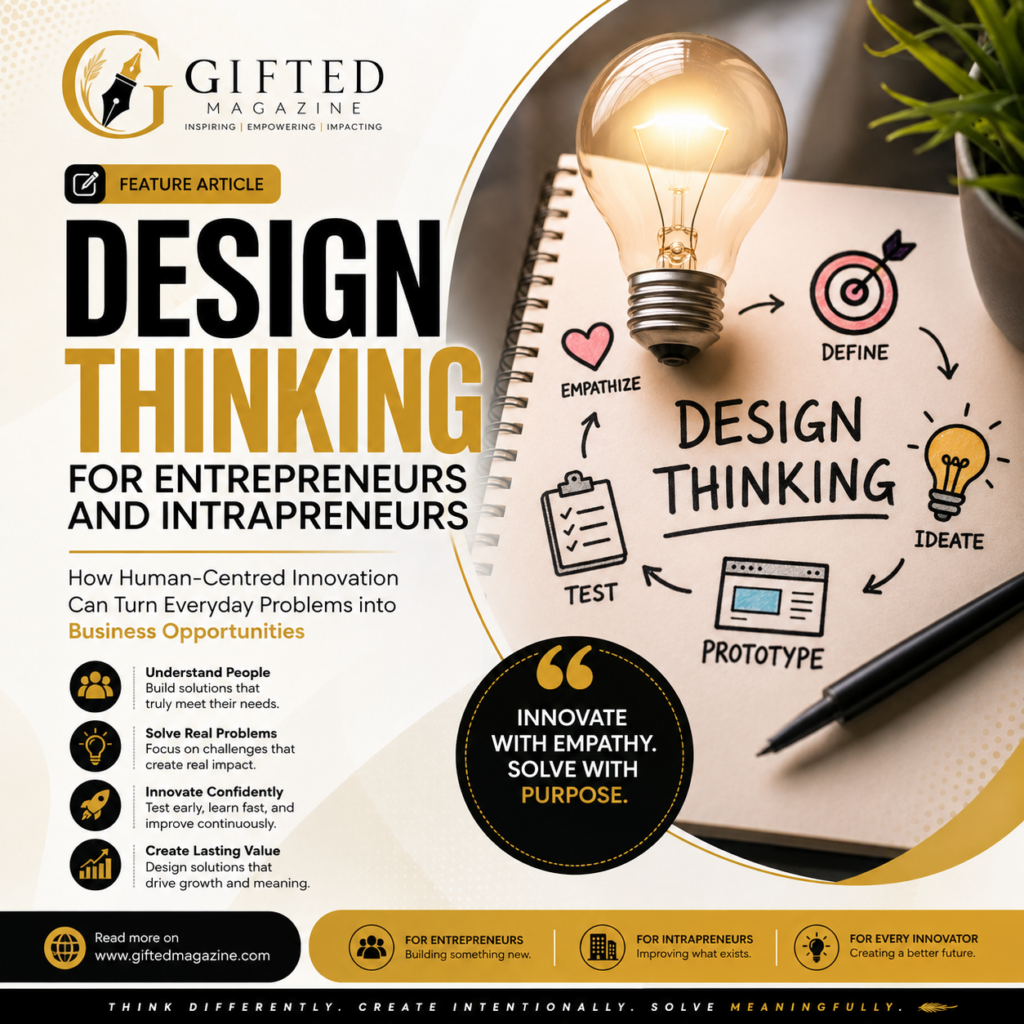
The process is commonly organized around five stages:
- Empathize — Understand the People: Before creating a solution, understand the people who will use it. Talk to customers. Observe their behaviour. Listen to their frustrations. Understand their goals and experiences.
Empathy helps entrepreneurs move beyond assumptions and discover what people truly need. - Define — Identify the Real Problem:
Once information has been gathered, the next step is to define the problem clearly.
A vague problem produces vague solutions.
Instead of saying:
“Customers don’t like our service,”
A design thinker might discover:
“Customers find the registration process complicated and abandon it before completion.”
The second statement provides a much clearer direction for innovation. - Ideate — Explore Possibilities
This is where creativity takes centre stage.
Entrepreneurs and teams generate different ideas without immediately judging them. The goal is to explore multiple possibilities before selecting the most promising ones.
The key question becomes:
“What could we do differently?” - Prototype — Make the Idea Real
An idea becomes easier to evaluate when people can see or experience it.
A prototype can be a sketch, a sample product, a basic website, a mock-up, a service process, or even a simple demonstration.
The objective is not perfection.
The objective is learning.
Creating a simple prototype allows entrepreneurs to test their assumptions before investing significant time and money.
- Test — Learn, Improve and Repeat
Put the prototype in front of real users.
Ask questions. Observe their reactions. Gather feedback.
What worked?
What didn’t?
What surprised you?
What should change?
The answers can lead to improvements—or even reveal that the original idea needs to be reconsidered.
This is why design thinking is often iterative rather than linear. Testing may take you back to defining the problem or understanding the customer again.
Why Entrepreneurs Need Design Thinking
Entrepreneurship is essentially about creating value by solving problems.
However, one of the most common mistakes entrepreneurs make is assuming they already know what customers want.
An entrepreneur might spend months developing a product, only to discover that customers don’t consider the problem important—or don’t want the proposed solution.
Design thinking helps reduce this risk.
Instead of investing heavily in an untested idea, entrepreneurs can:
• Research customer needs.
• Identify genuine pain points.
• Develop several possible solutions.
• Build simple prototypes.
• Test ideas early.
• Learn from customer feedback.
• Improve before scaling.
This approach can save resources while increasing the chances of developing a product or service that has genuine market value. By understanding people, defining meaningful problems, generating ideas, creating prototypes, testing solutions, and learning from feedback, individuals can transform challenges into opportunities.
In entrepreneurship, the most valuable idea may not be the most complicated one.
It may simply be the one that solves a real problem in a better way.
And sometimes, the next great business opportunity is hiding inside a problem that everyone else has learned to ignore.
CONCLUSION
Think differently. Create intentionally. Solve meaningfully.
What problem around you could become your next big opportunity?
This version is structured to read like a published Gifted Magazine feature, rather than a standard blog article, while keeping it accessible and professional.
About The Author
Discover more from Gifted Magazine
Subscribe to get the latest posts sent to your email.